ISLE OF HARRIS
For information on the Island of Taransay used for the TV documentary 'Castaway 2000' click HERE
Eilean na Hearadh
Eilean cùbhraidh nam beannaibh
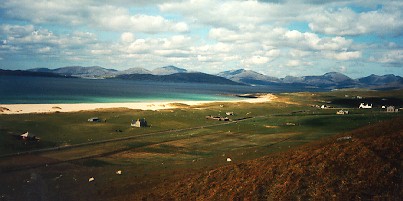
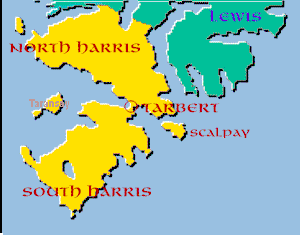
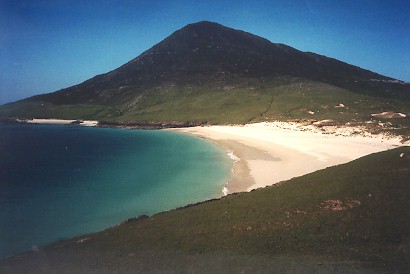
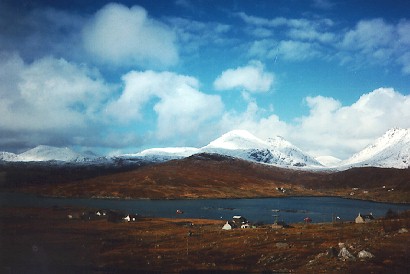
The island of Harris is an island of mountains, beaches and rock. Its allure lies in the contrasting landscape of spectacular sandy beaches, high hills and the rocky lunar landscape of the East Coast. Harris is referred to as an island, even though it is attached to the Isle of Lewis. They are separated by mountains which in the past were as divisive as any stretch of sea.
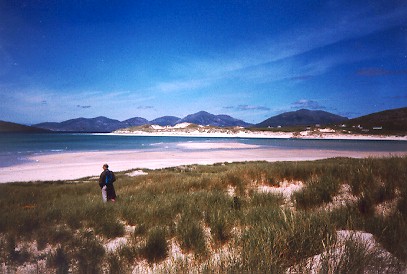
On the west coast of Harris, you can experience the carpets of wild-flowers on the machair, the pure white deserted beaches, and the luminous colours of the sea, ranging from aquamarine to an incredible red, where the peat-coloured rivers cross the white sands.
On the east coast of Harris, or the Bays, the visitor can enjoy clean air, peace, and above all the incredible colours of the sea, moor and rock. The coast is a succession of little bays; deep blue sea fringed by luxuriant growth of seaweeds. Along the shores are the villages of the Bays — surely one of the most inhospitable lands from which to wrest a living — and behind them, the moors and the mountains — an incredible rock-scape of greys and browns, shot with whites and purples, and the azure blue of hundreds of lochs.
The ideal way to see the Bays is on foot, or by cycle. Roads run along the shores, twisting around the lochs — but the driver sees little of the surrounding scenery — his attention has to be concentrated on the road ahead! So leave the car at a safe parking place, and enjoy the Bays on foot — you will have more chance to explore the little by-ways, and be able to appreciate the smells of the sea and of the peat-smoke, away from the smell of exhaust fumes!
HISTORIC SITES
There are many indications of the island’s rich and ancient past. Clach MhicLeoid above the beautiful beach of Traigh an Iar at na Buirgh and Clach Steinigrie on the machair of Sgarasta have been sentinels of the West Coast for many centuries, possibly dating back to the era of the Callanish Stones in neighbouring Lewis. These were probably primarily calendar stones, with the length and position of the shadow telling the seasons, but they were also the sites of religious rites, as well as landmarks from the sea.
Many traces of Iron Age sites lie beside the white beaches of Harris and you can still find their middens, or refuse heaps, of empty shellfish, and occasionally pottery.
VIKINGS
The Western Isles were taken over by the Norsemen in the 9th century, and their influence can still be seen in their place-names, which are still in use, in a Gaelic guise, ‘—bost’ for a village, as in Seilebost and Horgabost, ‘—val’ for a hill, as in Bleabhal and Chaipabhal, and ‘—vat’ for a loch, as in Langabhat and Cistabhat, are examples.
On the east side there are ‘—settr’ for a grazing, as in Drinisiadar, ‘—vagr’ for a bay, as in Miabhag and Fionnsbhagh and ‘—vik’ for a creek, as in Beacrabhic, are examples. The evidence of place-names suggests that the Norsemen may even have had one of their main bases in the Bays, as Scadabhagh can be translated from Norse as Tax bay, the natural harbour where the king’s ships from Norway came to collect taxes from the settlers in Harris.
CLAN MACLEOD
By the sixteenth century, Harris belonged to the Clan MacLeod of Harris and Dunvegan, with their main religious centre at Roghadal, at the southern tip of Harris.
St Clements Church at Roghadal is a magnificent legacy of Clan MacLeod’s ownership of Harris. It became the main church of the MacLeods in the early 1500s, when Alasdair Crotach MacLeod, the eighth chief of the MacLeods of Harris and Dunvegan rebuilt the church on a much older religious site. In 1528 he built a tomb for himself which is the finest of its kind in Scotland today. In the church too are the tombs of William, the ninth chief, and of John of Minginish. In the churchyard can be seen the grave enclosures of the main MacLeod families associated with Harris.
St Clements provided a lookout point for the eastern approaches to the Sound of Harris as did the Teampull at Northton to the western approaches. The Teampull is thought to have been rebuilt by Alasdair Crotach as well. Both these churches were built beside Iron Age forts, part of the chain of forts used to pass messages, by means of fire, in times of danger. St Clements is one of the main tourist attractions in the Western Isles, and the church is used for occasional weddings and for recitals of church music.
EMIGRATION AND CLEARANCES
Until the end of the eighteenth century, almost all the habitation of South Harris was on the machair and the offshore islands, and the Bays of the east coast were used only as summer grazings, but in the 1780s the Bays were settled as fishing villages. At the same time the landlords of Harris began to introduce sheep-farming to the Island, and in the 1800s the villages of the machair were gradually cleared, and their people sent to Cape Breton or the Bays, until by 1852 not a single crofter was left on the machair.
The whole area became sheep farms, and the remains of farm steadings can still be seen at Borgh Mhor, Sgarasta Bheag and Taobh Tuath (Northton). Later the farm at Losgaintir, which now included all the land north of na Buirgh, was made into a deer forest. Lochs were dammed to improve the fishing, like the Fincastle Pool at Losgaintir road-end, and the northern end of the machair was turned into a sporting estate, with the best land in Harris kept for feeding deer and rabbits!
The turbulent times of the nineteenth century Clearances have left marks on the landscape of Harris. The ruins of the houses left after the people were burned out of them by unscrupulous factors can be seen on the hill slopes of the west side of Harris, evocatively lying beside the long strips of cultivation called runrigs or lazybeds, created by the very people who were forced to leave . The island of Pabbay was cleared of all its population and the lintels are still in place over the doors of the houses there, 150 years later. On the island of Taransay a series of water-mills lie in the stream on the hillside.
THE ENVIRONMENT
It is sometimes said that Harris is an example of wilderness in its natural state, but this is not correct. The hill-slopes are ridged with feannagan, or lazy-beds, where the thin soil was heaped in ridges to give depth and drainage for the growing of crops and fodder. The green patches of the airighean or summer shielings dot the hills, and the sites of pre-Clearance houses can still be seen amid the nettles around their ruins.
FLOWERS
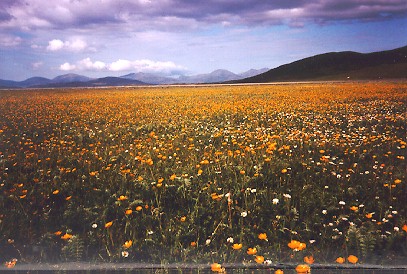
The Bays of Harris are home to a surprising range of vegetation. Heather covers the moors, often mixed with creeping juniper. Patches of wild iris surround the drains of the old lazy-beds, while creeping buttercup and other acid-loving plants cover the patches. Many of the Iochs are almost covered in the summer with white water-lilies, and bog-bean and water-violet fill the shallower pools. On the islands in the lochs can be found stands of smaller trees and bushes — mainly rowan and aspen, with willow and honeysuckle among them.
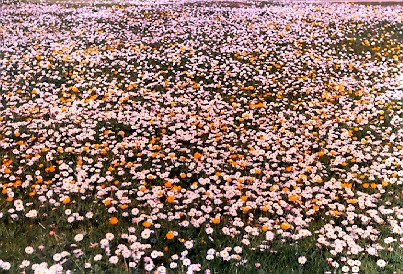
On the west coast there are wide meadows of sea-pink, or thrift, while the machairs behind them show daisies and buttercups, clover, orchids, harebell and knapweed, as well as the lowlier plants of gentian, centaury, eyebright and thyme. On the wetter lands there are clumps of iris, primrose and bog pimpernel, while the more acid peatlands are the home of heathers, milkwort and cotton-grass, as well as the interesting insectivorous plants of sundew and butterwort.
BIRDS
The machair side of Harris has a very varied bird life, since it has mountains, moors, machairs and shores all in close proximity. The buzzard and the golden eagle share the mountains with all too many ravens and hooded crows. The moors have populations of golden plover and snipe, and the strange humming sound of the snipe’s aerial display can be heard most still evenings.
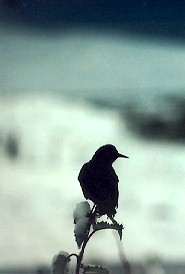
The arable ground attracts the rare corncrake, while the wetter areas of machair form the breeding ground for incredible numbers of wading birds — redshank, lapwing and ringed plover being the most common.
The seashores of the east are full of birds, from the stately heron to the sombre shag. The old lazy-beds are home to the pipit and lark, and the summer-visiting wheatear, while the cuckoo is a surprisingly common voice here. The moors have populations of golden plover and snipe.
ANIMALS
The rich shores of Harris are home to numerous otter and to the all-too-common feral mink. Seals are common on the offshore rocks, while the coastal waters may show porpoises and even basking shark. The rich fish stocks of the lochs have been depleted by commercial overfishing, but there are still many lochs where a pleasant evening can be spent in a boat, enjoying the surroundings — whatever the size of catch!
VIEWPOINTS
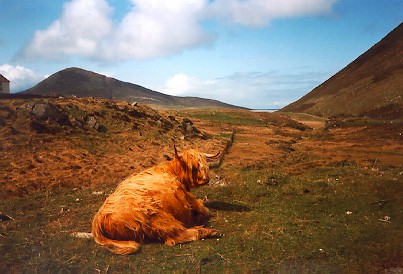
The Bays of Harris are full of interesting views, and some favourites are the seascape of East Loch Tarbert from the road above Ceann Dibig, the intricate mixture of land and sea in Manais as seen from the Carnan Mor, and any of the innumerable freshwater lochs, glinting among the rocks.
The machairs of Harris are full of arresting views. The colours of the sea-along the Losgaintir road in the evening light, the hills of North Harris seen above the sands from the parking place between Seilebost and Horgabost and the sands of Sgarasta from the parking place at the Golf Course, with the sun setting over the islands of St Kilda, out in the Atlantic, are only a small sample.
HARRIS TWEED
Harris is famous for having given its name to Harris Tweed. The first marketing of Harris Tweed was arranged by Lady Dunmore, the owner of Harris in the 1850s. She arranged to sell the cloth woven by the weavers of Harris to her own family and friends and so commercial Harris Tweed was created. Today the visitor to Harris can still see Harris Tweed being made on the croft using the single width loom, the old wooden loom, and even the new double width loom. The visitor can also see the process right through from the shearing of the wool to the finished garment.
TOURISM
There are modern day industries like fish-farming and tourism but the traditional industries of fishing and crofting are still providing a living for some. As a few of the tourism operators are crofters it is possible to see various aspects of crofting like peat-cutting and sheep-shearing.
The Gaelic language is an added attraction for the visitor. You will hear it as you visit shops and walk along the streets, and it is the language of many Harris homes. Many entertainments feature Gaelic singers.
Harris has two ferry ports, Tarbert and Leverburgh, with ferry connections to Skye and North Uist. Stornoway airport is within easy driving distance. The hotel in Tarbert is an old established family business, and there are numerous bed and breakfast facilities in the island. There are bunkhouse facilities throughout Harris and a Gatliffe Trust hostel in Reinigeadal.
Harris has a genealogy and exhibition centre in Taobh Tuath (Northton). Taobh Tuath also has the new centre named after William MacGillivary, the ornithologist , who lived in the area for a few years.
In the summer there are events like the Harris Arts Festival, Feis Eilean na Hearadh, South Harris Agricultural Show and the Western Isles Challenge. For further information and dates of events see separate pages on this website under the Diary.
We hope that you come and experience the magic of Harris.
To
return to Sitemap click on logo
Harris information on this page compiled by Co leis Thu? Genealogy Centre
